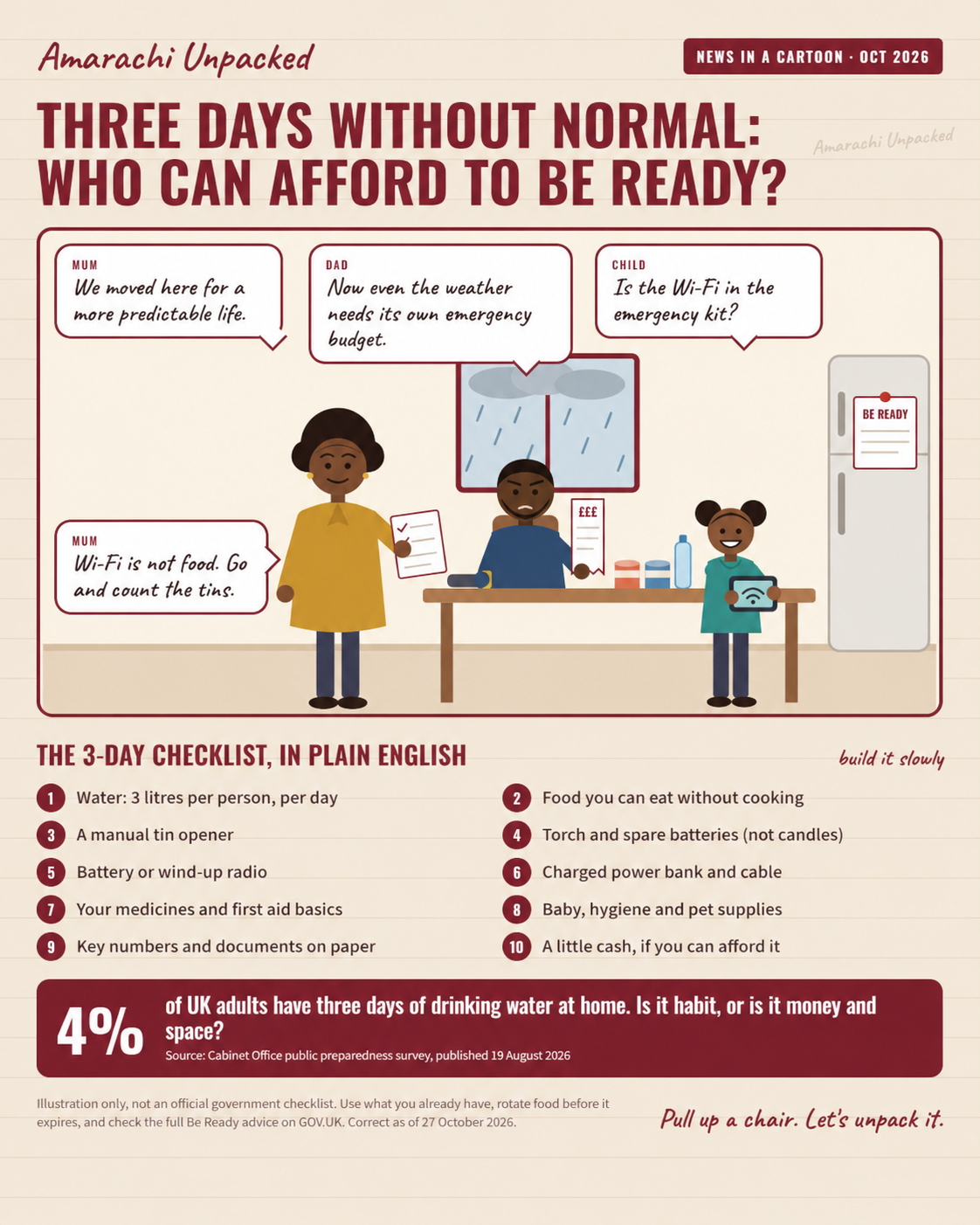
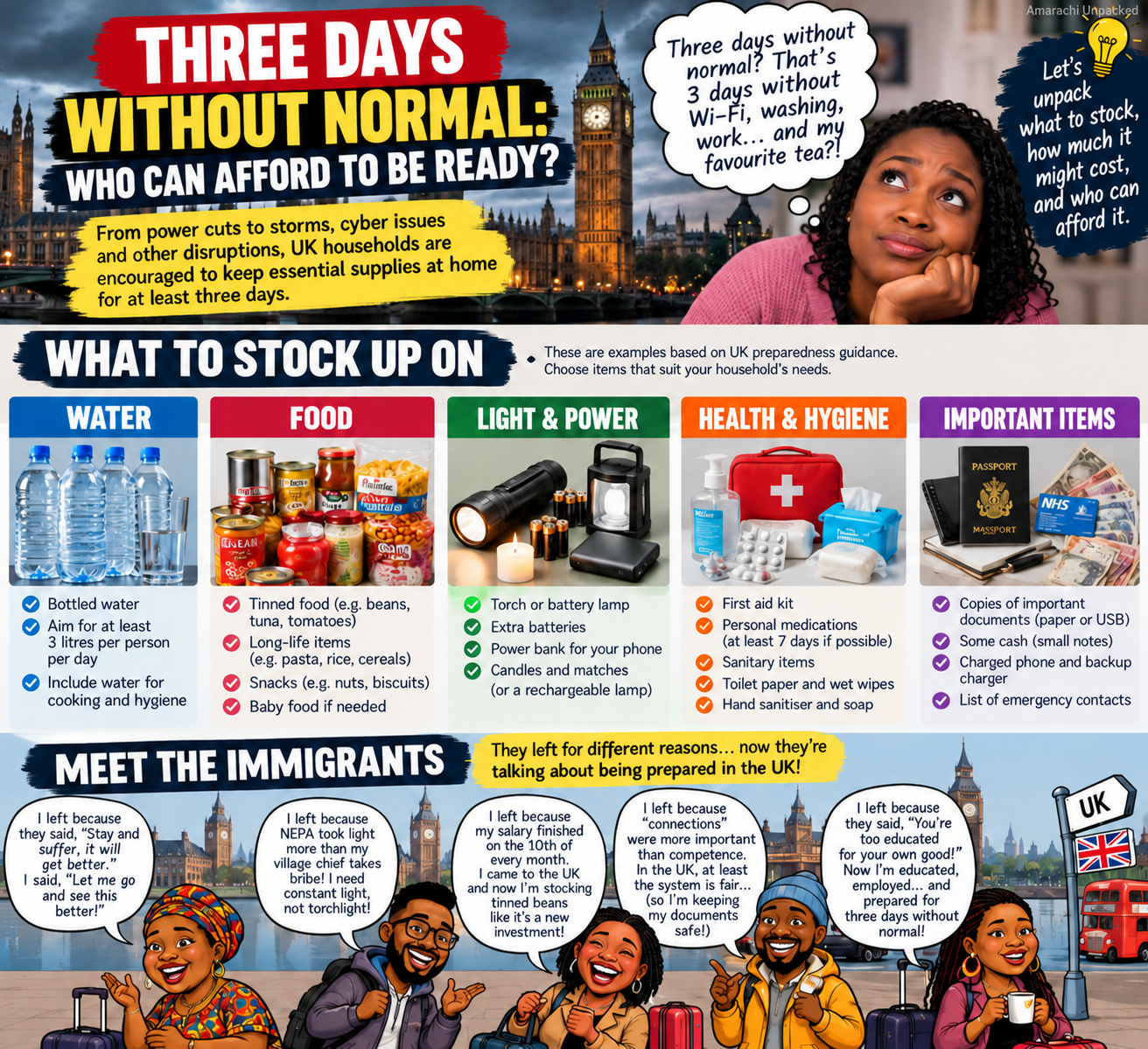
Safety note: The illustration mentions candles. The official Be Ready guidance recommends a torch, which is safer than candles.
Last Thursday, the British government asked every household a question many of us who grew up in Nigeria have been answering since childhood. If the lights, the taps and your phone signal all stopped tomorrow, could you cope for three days?
Pull up a chair. Let’s unpack it.
On 22 October 2026, the Cabinet Office launched Be Ready, the first stage of a three-year public campaign (GOV.UK announcement). It asks households to keep enough bottled water, food that needs no cooking, and a few basics like a torch and a radio to manage for three days if everyday services go down (official Be Ready checklist).
It is advice, not law. Nobody is checking your cupboards. It replaces the government’s older “Prepare” website, which has offered similar advice since May 2024. The three-day figure is the same one France, Ireland and the Netherlands already use.
So what is Britain preparing for?
The honest answer is less dramatic than some headlines. The official announcement points to last winter’s storms and this summer’s wildfires, and to the way bad weather can knock out power, water, phones and the internet. The Be Ready guidance lists fire, flooding, power cuts, storms, heatwaves and snow. The government’s own release does not mention war.
Some outlets reported it as war preparation anyway. That framing came from commentary, not from the guidance. If you saw a video saying “Britain is preparing for war”, that is not what the published advice says.
The real “why” is triage. The Security Minister’s argument is that if households who can cope for a few days do so, emergency services can focus on people who cannot. The campaign names older people and families with young children as most at risk. Your torch and tins are not really about you. They free up help for someone else.
Who can actually afford to be ready?
This is the part the checklists skip. Listen closely to how the minister launched it: “Those who can follow this advice should follow this advice.” That sentence admits that not everyone can.
The government’s own survey shows how wide the gap is. Measured against the campaign’s own standard of three litres of drinking water per person per day, only 4% of UK survey respondents had three days’ worth of bottled water for their household (Cabinet Office survey, published 19 August 2026).
When the same survey asked what stops people preparing, the most common answer was not laziness. It was money. After that came worry about food going to waste, not knowing what to do, finding the subject stressful, and simply having nowhere to store anything.
The Trussell food bank network said many people already struggle to cover food and bills each week, so they have nothing spare to set aside. Its view is that asking people to prepare is “only fair if there’s a plan for those who can’t” (LBC). To be fair to the government, it says the campaign was built with charities working with people who use food banks and people in insecure housing, and that several steps cost nothing.
Think about who “nowhere to store anything” really describes. A student in one room. A new arrival in a shared house with one kitchen cupboard. A family in temporary accommodation. A nurse renting a box room while saving for a deposit. And one more catch: the survey was run online, so people without reliable internet access, often the least prepared, may not be fully counted.
What a Nigerian upbringing teaches about “three days”
For a lot of us, this checklist is not new. It is a Tuesday. Many Nigerian homes keep water in drums or a tank because the taps are unpredictable. Rechargeable lamps sit by the door. There is cash in the house because the network is down again. Nobody calls it resilience. It is just how the house runs.
This is the reality of today’s modern world. We live in an era of disruptive technology, relying on connected services for so much of everyday life. Being prepared can mean living partly in the modern world and keeping a little of the old ways close at hand: a torch or lamp, water, food and important numbers on paper. If disruption comes, those simple backups help us cope when technology cannot. The UK’s call to prepare brings that reality home.
There is a real lesson in that, and a real warning. The lesson: preparedness works best as a habit, not a shopping trip. You rotate what you store into normal meals, you know your neighbours, and you keep a written list because phones die.
The warning: in Nigeria, the cost of being prepared falls on each household, and the households that can least afford a generator or a water tank go without. Britain is asking for a backup to services that mostly work, which is a very different thing. But the question underneath is the same one: when the system asks people to look after themselves first, who gets left behind?
The one thing to do this week (it is free)
Check whether your household can join the Priority Services Register. It tells your electricity, gas and water companies that you may need extra support, including when supplies are cut off. The official guidance says lots of households are eligible, including those with children under five. Check at thepsr.co.uk. In Northern Ireland, ask your supplier about its Customer Care Register.
While you are there, write the power cut number, 105, on paper with your other key numbers and any medicines and doses. The 105 service covers England, Scotland and Wales. When the phone dies, the paper still works.
If you want to go further, the official advice is to check what you already have first and add things slowly during normal shopping, not in one big trip. If you genuinely cannot afford to put anything aside, that is not a personal failing, and you are exactly who this campaign says emergency help is being kept for. If you can afford a little extra, the official checklist suggests sharing spare supplies with someone who cannot.
Over to you
If your power, water and internet went off tonight, how many days could your household honestly manage, and what is stopping you from managing longer?
Tell me in the comments. I read every one.
Correct as of 27 October 2026. This article explains published government guidance and is not personal advice. Amarachi Unpacked is independent and is not affiliated with or endorsed by the government.
Amarachi Unpacked | Explaining how the world is changing
Sources
Cabinet Office: Households encouraged to take small, simple steps to stay prepared in an emergency, 22 October 2026.
GOV.UK: Be ready for emergencies and the Be Ready checklist.
Cabinet Office: UK Public Survey of Risk Perception, Resilience and Preparedness 2026.
LBC: Millions cannot afford emergency supplies, food charity warns.